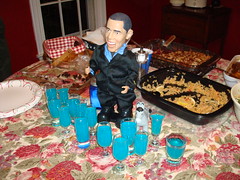
April Fools or Real Life?

Excerpted from The Hill on The Net: Congress Enters The Information Age

In March 1994, an acquaintance forwarded to me an E-mail message he had received from a mailing list to which he subscribed.  The message referred to a column by John C. Dvorak that appeared in the April 1994 issue of PC Computing magazine, and described a legislative effort under way in the United States Senate.

In his column Dvorak described Senate Bill 040194, a bill “designed to prohibit anyone from using a public computer network (Information Highway) while the computer user is intoxicated”, and also make it illegal to “discuss sexual matters”.  The bill, sponsored by Senator Patrick Leahy and co-sponsored by Kennedy, was crafted by members of Congress who know so little about computer networks that they think the “Info Highway” is an actual road.  The column reported Senator Pat Moynihan asking “if you needed a driving permit to ‘drive’ a modem on the Information Highway!  He has no clue what a modem is, and neither does the rest of Congress”.

One ominous result of the bill was the FBI’s plans to conduct wiretaps “on any computer if there is any evidence that the owner uses or abuses alcohol and has access to a modem.”  A new law enforcement group called the Online Enforcement Agency was said to be placing want ads soliciting wiretap experts.

With strong support from Baptist Ministers and no member of Congress willing either able to understand technology or “come out and support drunkenness and computer sex”, the bill was on the fast track to passage.  Readers were told they could register their complaints with Ms. Lirpa Sloof in the Senate Legislative Analysts Office, whose “name spelled backwards says it all.”

I would have probably found the column to be more amusing had I not been frustrated at how it had chosen to pick Senator Kennedy as a target.  But the last thing I’d expected was that anybody could actually believe it to be true.  I did have the advantage of certainty.  I knew this story was not true.  And there were plenty of clues in the story itself to help reader reach that conclusion.  The title, “Lair of Slop”, is an anagram for April Fools.  At the end of the column, “Lirpa Sloof…Her name spelled backward says it all.”, April Fools.  And the bill number itself, 040194, a date, April Fools Day.  But even these clues did not prevent a large number of people from believing it.  It didn’t take long after PC Computing hit mailboxes and newsstands before the first calls and E-mails began arriving in Kennedy’s office, followed shortly by faxes and letters.  The offices of the other Senators mentioned in the article also started hearing from outraged constituents.

I was surprised that people could believe the story, but my surprise grew even more when people I knew personally and who knew of my efforts to put Senator Kennedy online told me of their concern over this bill.  Even Jonathan Gourd, sysop of North Shore Mac, the BBS on which Kennedy’s online efforts had begun, posted a message to his system encouraging readers to contact Congress and protest this bill.  The whole tale was taken as fact by an even wider audience after initial messages of alarm, posted by people who’d read and believed the article, convinced many others of the Senate’s evil intentions without them having had the opportunity to read the story and perhaps catch the clues for themselves.

It was apparent that this story had the potential to become an “urban legend” of the Net.  Just like other oft retold and wildly inaccurate stories such as the one about the proposed FCC modem tax or the dying boy who wanted Get Well cards, the Senate’s Information Highway Drunk Driving Bill was proving to be a tale with legs that could rapidly traverse the Net.

In an attempt to prevent Dvorak’s column from spawning another net legend, I posted an explanatory message (with the article included) to the ACE groups mailing list and encouraged readers to repost it where appropriate to help prevent the rumor’s spread.  This message did get around and was reprinted in the widely read RISKS-FORUM Digest among other places.  On March 30 a brief article about the hoax appeared in the Washington Post.  These efforts seemed to work, calls from concerned constituents decreased.

In late October I received an E-mail message from a gentlemen who described himself as a Ph.D. in physical chemistry and an Internet user.  He wrote that he had read the article and was concerned about this bill.  Explaining passionately why he felt the bill was wrong, he offered his own expertise to Senator Kennedy as a scientific consultant to help prevent such misguided legislation.  I e-mailed him an explanation and by that afternoon he’d sent a note expressing his own embarrassment at having missed the clues and believed the story.  He was the last person I heard from on the subject.

In the year following Dvorak’s April Fools stab at the Senate, the Senate passed the Digital Telephony or wiretap bill.  It’s purpose is to protect the government’s ability to eavesdrop on the Information Superhighway.  In June 1995 the Senate passed the Communications Decency Act, a bill sponsored by Senator Exon of Nebraska, an effort to “clean up” the dark alley’s of the Internet and make them safe for children.

I have a much better understanding now of the people who didn’t see the humor in John Dvorak’s April Fools joke.  Ironically, Senator Leahy has been the Senate’s most outspoken advocate for protecting the Net from misguided and damaging government intrusion, and not the sponsor of such as Dvorak’s column made him.  Kennedy and Moynihan, both made out as ignorant of the Net in the article, were actually both among the 16 Senators to oppose the Exon bill when it came to a vote in the Senate.


Keith Fimian’s Prayer List

Keith Fimian’s Prayer List

I can’t vouch for the authenticity of this email, purportedly from the campaign manager for Republican Keith Fimian’s challenge in my own congressional district (VA-11).

If real, I can only react with a tongue in cheek, OMG!

CyberTed’s Legacy Lives On

Among the flood of news coverage that immediately followed the death of Sen. Edward Kennedy last Tuesday night was an article in the Washington Post which mentioned that The Senator’s web site included, with the news of his passing, his famous closing words from his 1980 Democratic Convention speech, “For all those whose cares have been our concern, the work goes on, the cause endures, the hope still lives and the dream shall never die”. Much repeated in the days of tribute that followed, they are a fitting label for his legacy. The Senator’s web site itself wasn’t the news; it was simply a conduit, a routine and expected place from which to learn information about Senator Kennedy and his work. Because of course, every Member of Congress has a web site.

That wasn’t the always the case.

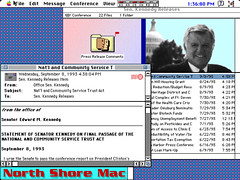
Kennedy on North Shore Mac BBS - 1993In 1993, any Senate office that was attempting to explore and utilize this recently heard about ‘Internet’ thing generally had to find their own way, without any institutional help from the famously slow-to-change Senate. At the time, I was working as Senator Kennedy’s Systems Administrator, a poli-sci type with no real technical background, hired on to support Kennedy’s network of Macs. When our office began to post his press releases and to solicit public comment via a network of dial-up computer Bulletin Board Systems (BBS), we found the effort was regarded as both newsworthy, and praiseworthy. While not everyone who found Sen. Kennedy online necessarily agreed with him on every issue, his effort to use new technologies to share his positions was widely reported and universally applauded.

A happy coincidence helped to boost Kennedy’s online reach beyond the BBS’. After reaching out to the White House staff who were likewise breaking new ground for President Clinton, I was put in touch with two of the students at MIT who were helping that effort, John Mallery and Eric Loeb. They were enthusiastic and eager to extend the work of MIT’s ‘Intelligent Information Infrastructure Project’ to include our nation’s Legislative branch. In short order they had setup the means for Kennedy’s press releases to be posted to an FTP archive at MIT and into two Usenet newsgroups. And eight months later, in the spring of 1994, they worked with our office to launch Kennedy’s web site, the first for a member of Congress. The site was located at MIT’s Artificial Intelligence Lab, as senate.gov provided only FTP and Gopher services by that time. And at the same time we announced Kennedy’s web site, we followed the example set by Senator Robb by establishing a public email address for The Senator and facing up to what remains today as a challenge to Congressional offices, managing and responding to torrents of inbound email.

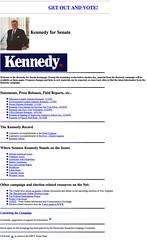
Kennedy Campaign - 1994In 1994 Kennedy had more than his Senate work to occupy him. He faced a strong challenge for his Senate seat by Republican Mitt Romney. Polls showed Kennedy was in a very tight race, with some even predicting his defeat. In the fall, the Democratic Senatorial Campaign Committee (DSCC) had contracted with Issue Dynamics Inc. to help develop a basic web site for each of their Senate candidates. Aware of Kennedy’s efforts to bring his Senate office online, the DSCC gave his campaign staff direct access to manage their campaign site and to make it their own. Senate rules designed to prevent incumbent Senators from using franked mail in support of their campaign were now interpreted to require shutting down their official online presence for 60-days prior to any election in which they were a candidate. The campaign’s web site kept Kennedy online, while his Senate site was shuttered.

Launched only a few weeks prior to Election Day, the campaign site contained issue papers, press releases and endorsements (the notion of actually raising money online was still little more that a geeky politico’s daydream). For his part, Romney was missing online, and was chided in the media for it. Kennedy ended up beating Romney handily. A Newsweek article reporting on the growth of online politics dubbed him ‘CyberTed’ and reported of his online campaign, “It helped counter his image as an out-of-touch baron who reeked of Old Politics. And it impressed the world of computer jocks, thousands of whom work in the important Boston branch of the industry.” The Internet had played some small part in keeping Kennedy in office.

I left Kennedy’s office in the spring of 1995 to join a new ‘Technology and Communications Committee’ created by the new Senate Democratic Leader, Senator Tom Daschle, to help other Senate Democrats follow in the path Kennedy had blazed online. But continuing to lead and to innovate online remained a high priority in Kennedy’s office. My successors there saw to the continued development of his Senate web site, as well as bringing the Senator online by other means such as into Q&A sessions with constituents in online chat rooms. By June of ’96, Senator Kohl became the 50th Senator with a web site, and it took four more years until all 100 Senators had one, when Illinois freshman Peter Fitzgerald launched his site early in 2000.

His online experience did more than just generate good press for Senator Kennedy; it informed his positions on important votes for which many of his less net-savvy colleagues were ill equipped to fully understand. One early example came when the Senate voted in 1995 on Senator Exon’s ‘Communication’s Decency Act’, a far-overreaching effort to censor adult content on the Internet, the bill passed by a vote of 84-16. Kennedy was on the right, but losing side of this vote, and it was left to the Supreme Court to overturn the act as unconstitutional two years later by a unanimous vote.

Outside groups have also played an important role in pushing Congress to do more than just ‘be’ online. The Congressional Management Foundation’s periodic ‘Golden Mouse Awards’ recognize the best of Congressional web sites and provide all offices with needed assistance and best practices for use in developing their online presence. Newer organizations such as The Sunlight Foundation support efforts to make Congress ‘more meaningfully accessible to citizens’, with the Internet at the core of their efforts. And early online guides to Congress such as CapWeb, which helped net surfers find Congress online, have passed the torch to newer resources such as Tweet Congress, which helps all to find members who are on Twitter.

On Saturday I joined hundreds of other current and former Kennedy staff on the steps of the U.S. Senate, waiting on The Senator’s funeral motorcade to make a scheduled stop, en route from Andrews Air Force Base to Arlington Cemetery, for a brief and final farewell from the institution he served for forty-seven years. With the motorcade more than an hour behind schedule, I wasn’t alone in following the tweets from ‘kennedynews’, which kept us informed of their progress. Kennedy’s current team has done him proud this last week by their use of the Internet to share news and information about his funeral arrangements as well as the legacy of his life in public service.

It’s easy to take for granted that the Internet has become an expected means of communication for public officials and for the candidates who aspire to become one. And the time has long passed when anybody was impressed by a politician just for being aware that the Internet existed, and for attempting to use it. Senator Kennedy benefitted from such early praise, and might have left it at that. But he ‘got it’ and instead chose not to let up after those earliest steps. He chose to value innovation, and to make the use of new technology a high priority in conducting his very public life.

The Senator’s legacy will live on in the legislation he passed and the causes that he championed.

Teddy’s legacy will live with his family, friends and loved ones.

And CyberTed’s legacy will live on… online.

Palin Running & Not

Sarah Palin image by Brian Adams from the August 2009 issue of Runner's WorldEach issue of ‘Runner’s World‘ magazine, a read I’ve been enjoying since taking up running again a year ago, ends with an interview with a generally well-known figure; athletes, actors, politicians and such. These interviews are called ‘I’m A Runner‘, and I enjoy reading them and learning of this lifestyle that I’ve embraced and have in common with these individuals.

This week, the August issue of Runner’s World came out, and the subject of the ‘I’m a Runner’ interview was Sara Palin. I enjoyed the interview and was impressed to learn of her having run a sub 4-hour marathon, or that she will still venture out to run in 20-below temperatures (although this reinforces my belief that she is also bat-shit crazy).

The interview made some minor buzz, because in it she claimed she could beat Obama in a race due to her higher endurance. A soft political jab at worst that got mentioned at the next briefing by White House Press Secretary Robert Gibbs. Maybe she could, it doesn’t matter. I’m still glad to have a bodysurfer (and smart person) in the White House.

But despite political differences, the interview reminded me that their are things that can connect us despite our differences; political, religious, or whatever. I wouldn’t want to join her on a run, because according to her interview, she prefers to run as a solitary activity, as do I most of the time. I had a similar reaction recently when I found I had a new Twitter follower. A look at her profile showed her to be a Communications Director of an county-level GOP party in Indiana. So why would she have any interest in my occasional Dem rants? A closer look showed she was a Cubs fan, and that was likely the connection that led her to me. Hobbies, sports, music, alma maters… all provide reasons to sometimes ignore a larger difference (for a moment at least), and recognize these things we do have in common.

Don’t get me wrong. Politically, I loathe Sarah Palin. Her selection as McCain’s running mate was a desperate, but doomed attempt to change the dynamics of the race. Over the course of the campaign, she repeatedly demonstrated herself to be clueless on the issues, and little more than an attractive and expensively dressed windbag shouting nonsense about Obama ‘pal-ing around with terrorists’. But I enjoyed learning she’s a runner, and admire her stated appreciation and ability at the sport.

An hour ago, news broke that Palin has announced she will resign her position of Governor of Alaska by the end of this month, and won’t be seeking re-election in 2010. Many speculate that she is doing so in anticipation of running for President in 2012. She would be not running for Governor in 2010, to allow her to run for President in 2012. That will be worth quite a few laughs in the years to come.

So keep on running Sarah. When for office, I’ll oppose. But when for the joy and exercise of the activity itself, I wish you the best. Break a leg! 🙂


Jeff Frederick

My Delegate to the Virginia House of Delegates is Jeff Frederick. He also happens to be the Chairman of the Republican Party in Virginia. He’s been making so much of the wrong sort of news, that it almost feels redundant to repeat, but at the same time it’s too good not to share.

Last week, Virginia’s Senate Republicans sought to tip their balance away from the Democrat’s narrow 21-19 majority by luring Democrat Ralph Northam to switch sides (in the event of a 20-20 tie, our Republican Lt. Governor would cast tiebreaking votes). Frederick’s Tweet about the looming switch tipped the Democrats off the the scheme and allowed them to thwart it.

On the heels of that, Frederick offered this bizarre slam against Charles Darwin on the floor of the House of Delegates…

The next day, Frederick announced that he will not be seeking re-election to the House of Delegates, and has offered up his wife Amy as “just that person to continue the work I started”. Jeff has shown he’ll be a hard act to follow. Best of luck to Amy, but I’d be happy to see Jeff’s work come to an end.

for further reading…

After Resigning Seat as Failure, Frederick Denounces Darwin
NBC News, Washington, DC 2/13/2009

Va. GOP Chair Out … Wife May Be In?
MSNBC, 2/14/2009

“and non-believers.”

This guest column from The Washington Post captures my feelings about Obama’s inaugural shout out to the non-religious very well.

This Land Is My Land
by Nica Lalli
The Washington Post, 1/23/09

Congratulations President Obama!

Ready for Blue MeaniesThe countdown ends, and a new era begins. Good riddance George Bush, and Good luck Barack Obama.

One…

One day to go (actually it was yesterday, this is a post-dated blog post). We spent our day prepping and then partying (stay tuned for photos).

Media_httpchriscaseyt_kbhhz

Goodbye George, and right back atcha!

Two…

PEACEAmazing. Just two days to go! I’m watching the Lincoln Memorial concert right now, while also house cleaning and preparing to go shop for party supplies for our major ‘Bush’s Last Day!’ party tomorrow.

There’s a small twinge of regret for having decided not to fight the crowds to participate in any inaugural events up close, but it’s a very small twinge. Last year’s Election was a family affair here at the Casey’s, and it will be great fun taking it all in together, warmer and with a better view on TV.

Count it down… 2!

Three…

That’s all there is to say… three! And it’s late, so we’re almost already down to 2!

Update: I found something share-worthy! Olberman his offers ‘Eight Years in Eight Minutes’ recap of George’s two miserable terms in office.

1 2 3 4 5 17