
The Pullman Case

When I discovered that my Great Great Uncle Edward Casey worked for the Pullman Company in Chicago for 42 years I became interested in learning more about life working for Pullman, living in his company town, and the landmark strike of 1894 and legal battle that followed. Searching on Amazon, I ordered The Pullman Case to read up on the subject. I was a bit disappointed when it arrived to see what a thin volume it was. I had hoped to find something that provided a real sense of what it was like to be a Pullman employee in Chicago in 1894, and this was not the book to fill that need.

It did, however, provide a bigger picture view of things. Where I was looking for a book about a single tree, I got a overview of the forest. The title of the book is ‘The Pullman Case’ after all, at it gave background on the Pullman Company, it’s founder George Pullman, his company town and the workers he employed. But this book also introduced the labor leaders, politicians, prosecutors and defenders who carried out the struggle in the courtrooms. Of particular interest to me was the amazing extent to which the government worked directly with and for the railroads. I was interested to learn that a young railroad attorney, Clarence Darrow, switched sides to defend the workers.

George Pullman died in 1897. So fearful was he that the hatred he had engendered among his workers would lead them to dig up and desecrate his body, that he was buried in one of his own train cars, under crisscrossed iron rails with cement poured on top.

My Great Great Uncle Edward Casey worked for Pullman’s company until 1927 and died a year later in 1928. I may never be able to uncover exactly how the turmoil of the time affected him personally, but in gaining a broader understanding of the time and place, I think I can at least get closer to understanding what it must have been like.
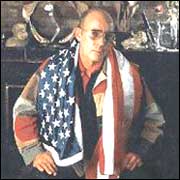
Dr. Hunter S. Thompson

Very sad news tonight. Hunter S. Thompson was found dead of an apparent self-inflicted gunshot wound. He was 67 years old.

I am a huge fan of Thompson’s work. I can remember my first introduction to it, when my brother read me passages from Fear and Loathing in Las Vegas. That introduction let me to move from one book to the next. You really couldn’t go wrong with any of his books.

Of all of them, I most appreciate his volumes of letters, particularly the first volume, The Proud Highway. A tireless correspondent, the letters introduced me to a young Thompson, who would eagerly engage friends and strangers in thoughtful and funny letters that he carefully maintained copies of, knowing that someday even they would be a worthy read for a larger audience.

Once, while I was at UC Santa Barbara in 1986, Thompson visited our campus for a lecture. The event was a sell-out and I had no ticket, but since my job on campus was as a projectionist, I was able to worm my way into watching from the rear projection booth. With his Dunhill hanging from a cigarette holder, and a glass of Wild Turkey, he gladly entertained questions from students in the packed auditorium. It was great.

Thompson said, “When the going gets weird, the weird turn pro“. He was a pro, and he will be sorely missed.

A Series of Unfortunate Events

This weekend, for my son Will’s birthday, we’ll be taking a crew of boys to the movies. And the film of choice will be A Series of Unfortunate Events. But before going to see the film, I decided to crack the books. The books have been favorites with the kids, and we have something like ten volumes of the series lying around, so I got my hands on ‘The Bad Beginning: Book the First’ last night and finished it this morning. It was great.

And now I’ve just finished ‘Book the Second: The Reptile Room’. And it was as good. The writing is wonderful. Throughout the books, which are offered as a retelling of these unfortunate events in the voice of Lemony Snicket, our storyteller frequently turns directly to the reader to offer a funny but practical definition of a term used or to describe some dramatic element as in these snippets of an excerpt which describe “dramatic irony”.

There is a type of situation which occurs all to often and which is occurring at this point in the story of the Baudelaire orphans, called “dramatic irony”. Simply put, dramatic irony is when a person makes a harmless remark, and someone else who hears it knows something that makes the remark have a different, and usually unpleasant, meaning.

As you and I listen to Uncle Monty tell the three Baudelaire orphans that no harm will ever come to them in the Reptile Room, we should be experiencing the strange feeling that accompanies the arrival of dramatic irony.

For no matter how safe and happy the three children felt, no matter how comforting Uncle Monty’s words were, you and I know that soon Uncle Monty will be dead and the Baudelaires will be miserable again.

In fact, from the book’s dedication “For Beatrice – My love for you shall last forever. You, however, did not.”, to the rear cover warnings that remind readers that they are “free to put this book back on the shelf and seek something lighter”, the books are draped in dark foreboding and doom.

They remind me of the dark, but still tremendously amusing, works of Edward Gorey, of whom I am a big fan. When my daughter wondered how it is that these books come off as funny, when the story is so tragic, I didn’t have much of an an answer. But I shared a copy of Gorey’s classic and grisly alphabet book The Gashlycrumb Tinies with her. I guess it’s the same reason we can laugh at someone else’s painful fall in a ‘Funniest Videos’ episode. Sometimes we just have to laugh at pain and misery, especially if it’s someone else’s.

A am very much looking forward to catching up on the nine books in the Unfortunate Events series that I still have to read. Will Count Olaf be the villain in all of them? Can he succeed at stealing the Baudelaire fortune from these unfortunate orphans? Can Lemony Snicket maintain the story, or will the formula get tired? Will the movie be any good? I don’t know, but it looks promising.

For further reading:

Dastardly Good
The Washington Post, 12/17/04

Out of This World: The Designer Behind ‘Lemony Snicket’
The Washington Post, 12/18/04

1 3 4 5